이 글은 greg nuckols의 "Squats are not Hip Dominant or Knee Dominant. Some Biomechanical Black Magic"을 번역한 글입니다. 이 글에 나온 생각은 오직 greg만의 생각입니다.
If you guys haven’t figured this out yet, I think about squatting a lot. It was the one lift that took a long time to “click” with me. Usually I can pick up a new movement pretty quickly, but squats were always uncomfortable and awkward for about half a decade once I started doing them. Because of the amount of work it took to master them, they now have a special place in my heart. I don’t think there’s a subject I’ve written more about, and I don’t expect that to change any time soon.
너는 모르겠지만 나는 스쿼트를 잘하기 위해 많이 고민한다. 나는 스쿼트를 잘 하게 되기까지 굉장히 많은 시간이 걸렸다. 나는 새로운 동작을 꽤나 빠르게 익힐 수 있지만 스쿼트는 내가 스쿼트를 처음 시작한 시기로부터 5년 동안이나 항상 불편하고 어색했다. 스쿼트를 숙달하기 위해 든 많은 양의 노력 때문에 스쿼트는 내게 있어 특별한 운동이 되었다. 나는 내가 쓴 글들에서 스쿼트를 가장 많이 다루었다고 생각하고 그 순위가 금세 바뀔 것이라고도 생각하지 않는다.
(잡담 생략)
Assuming you’ve read my last article and you have a basic understanding of torques, applied to the squat, it’s time to talk about Lombard’s Paradox.
너가 내 마지막 글을 읽었고 스쿼트에 적용되는 토크를 이해했다면 이제 롬바드의 역설(Lombard’s Paradox: 앉거나 쪼그려 앉은 자세에서 일어날 때 햄스트링과 사두근이 모두 서로에게 길항작용을 하면서 동시에 수축하는 현상)에 대해 이야기해볼 차례다.
W.P. Lombard was a biomechanist in the early 1900s, and he investigated an interesting phenomenon. When you walk or run or rise from a chair, the quadriceps and the hamstrings contract at the same time to cause movement. Your quads and hammies, however, are antagonists, producing opposing movements (hip extension and knee flexion for the hamstrings, and hip flexion and knee extension for the quads). “Why,” Lombard wondered, “don’t these antagonistic contractions cancel each other out?” Why don’t they just lock your hips and knees in place? Opposing muscles firing together seems like a great way to accomplish absolutely nothing, NOT sprint at high speeds or jump or move heavy loads.
Lombard는 1900년대 초의 생체역학자로 언젠가 굉장히 흥미로운 현상을 조사했다. 사람이 걷거나 뛸 때, 혹은 의자에서 일어날 때 그 움직임을 만들기 위해 사두근과 햄스트링이 동시에 수축한다는 것이다. 하지만 사두근과 햄스트링은 서로에게 있어 길항근으로 작용한다. 햄스트링은 고관절 신전과 슬관절 굴곡을, 사두근은 고관절 굴곡과 슬관절 신전을 일으킨다. 롬바드는 왜 이 길항적인 수축이 서로의 작용을 상쇄시키지 않는지 궁금해했다. 왜 이러한 현상이 고관절과 슬관절을 같은 자리에 움직이지 못하도록 고정 시키지 않는 것일까? 길항 관계에 있는 근육들이 동시에 수축하는 것은 전력질주나 점프, 무거운 부하를 이동시키는 것에 있어서는 좋은 방법이 아닌 것처럼 보인다.
The answer, it turns out, has to do with the different distances from the hip and knee joint that the quads (specifically rectus femoris) and hamstrings originate and insert.
그것은 사두근(특히 대퇴직근)과 햄스트링의 기시점과 부착점의 고관절에서의 거리와 슬관절에서의 거리가 다른 것과 관련이 있는 것으로 밝혀졌다.
The hamstrings originate on the ischial tuberosity, and insert just below the knee joint, on the back of the tibia. The rectus femoris originates just above on hip on the anterior inferior iliac spine and the rim of the hip socket, and inserts a couple of inches below the knee joint on the tibial tuberosity, via the patellar tendon.
햄스트링의 기시점은 좌골결절(ischial tuberosity)이고 부착점은 경골 뒤쪽의 슬관절 바로 아래에 존재한다(figure.1). 대퇴직근의 기시점은 고관절 바로 위의 전하장골극(anterior inferior iliac spine)과 관골구의 상연(사진에서는 “groove superior to acetabulum”이라고 적혀있다.)이고 슬관절의 2인치 아래의 경골조면에 슬개골의 건(腱)을 경유하여 부착되는 부착점을 가진다(figure.2).
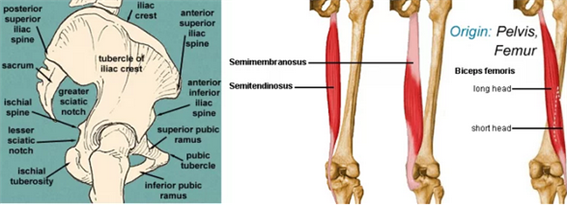
figure.1
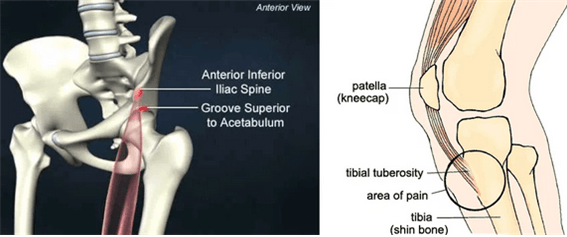
figure.2
Hamstrings: Origin a few inches away from the hip, and insertion very close to the knee
Rectus femoris: Origin just above the hip joint, and insertion a couple inches below the knee.
햄스트링:고관절에서 몇 인치 떨어진 곳에서 시작되어 슬관절에 매우 가깝게 부착된다.
대퇴직근:햄스트링과 반대로 고관절 바로 위(가까운 곳)에서 시작되어 무릎 아래 몇 인치 아래에 부착된다.
What that means is that when the hamstrings contract, the amount of hip extension torque they produce is considerably greater than the amount of knee flexion torque they produce. The opposite is true for the rectus femoris: It produces much more knee extension torque than hip flexion torque. Those basic facts “solve” Lombard’s paradox. Since the origins and insertions of these muscles mean the hamstrings are much more efficient at producing torque at the hips, and the rectus femoris is much more efficient at producing torque at the knee, when they contract together, you get both knee and hip extension.
이것은 햄스트링의 수축 시 발생하는 고관절 신전 토크의 크기가 슬관절 굴곡 토크의 크기보다 훨씬 크다는 것을 의미한다. 대퇴직근의 경우 이와는 반대로, 고관절 굴곡 토크의 크기보다 슬관절 신전 토크의 크기가 더 크다. 이 기본적인 사실들은 롬버드의 역설을 해결한다. 이 근육들의 기시점과 부착점은 햄스트링이 고관절의 토크를 생산하는 데 훨씬 더 능률적이고 대퇴직근은 슬관절의 토크를 생산하는데 훨씬 더 능률적이라는 것을 의미하기 때문에 두 근육이 동시에 수축할 경우 고관절과 슬관절이 모두 신전되게 된다.
Okay, cool. Co-contraction of the quads and hammies doesn’t give you rigor mortise. But what can we actually do with that information?
정리하자면, 사두근과 햄스트링의 동시 수축은 고관절과 슬관절의 경직을 일으키지 않는다. 그런데 이 정보를 현실에 어떻게 적용시킬 수 있을까?
Let me point you in the direction of a paper titled From Rotation to Translation: Constraints on multi-joint movements and the unique action of bi-articular muscles by G.J. van Ingen Schenau (1989).
Schenau가 1989년에 쓴 "From Rotation to Translation: Constraints on multi-joint movements and the unique action of bi-articular muscles"라는 제목의 논문이 말하고자 한 바를 짚어보도록 하겠다.
It was a study trying to figure out how, exactly, humans coordinate muscle contractions to move and transfer force so efficiently. The study itself examined speed skating, jumping, and cycling; however, the authors found the same principles to be in play for all three, and proposed that their findings are generalizable to all movements involving two-joint muscles (such as the hamstrings and rectus femoris) based on some basic physics and geometry. The model they propose makes a lot of otherwise-confusing facts about squatting make a lot more sense.
그 연구는 인간이 효율적으로 움직이고 힘을 전달하기 위해 어떻게 근육의 수축을 조정하는지 밝히기 위한 연구였다. 연구는 스피드 스케이팅, 점프, 사이클링(자전거)에 대한 연구였으나 저자들은 세 종목 모두에서 동일하게 적용되는 원리를 발견했고, 그들은 그들이 발견한 원리를 기초적인 물리학과 기하학을 바탕으로 하여 투 조인트 머슬(햄스트링과 대퇴직근)이 관여하는 모든 움직임에 일반화 할 수 있다고 발표했다. 그들이 제안한 모델은 스쿼트에 대한 다른 많은 논란들을 해결했다.
In their investigation of jumping, they examined the role of the quads in plantar flexion – pushing off the balls of your feet as you leave the ground for a jump. Of course, the quads don’t cross the ankle joint. If you cut all the other muscles away from the human body and contracted the quads, nothing’s going to happen at the ankle. However, force from the quads is transferred to the ankle by the gastrocnemius, which originates just above the knee and inserts on the heel. As the quads extend the knee, the gastroc would stretch slightly if it were relaxed. However, if it remains the same length or contracts, the lengthening that would otherwise occur due to knee extension is instead transferred to the ankle where it aids in forceful plantar flexion.
그들은 점프에서 족저굴곡에서의 사두근의 역할을 조사했다. 사람은 점프를 하기 위해 땅에서 멀어질 때 앞꿈치(the balls of your feet: The ball of the foot is the padded portion of the sole between the toes and the arch, underneath the heads of the metatarsal bones-출처:wikipedia)를 강하게 밀어낸다. 물론 사두근은 족관절을 가로지르지 않는다. 사두를 제외한 다른 근육들을 모두 잘라낸 상태에서 사두를 수축시킨다면 발목에서는 아무 일도 일어나지 않을 것이다. 하지만 실제로 사두의 힘은 무릎 바로 위에 기시점을, 뒤꿈치에 부착점을 가지고 있는 비복근에 의해 족관절에 전달되게 된다. 사두근이 슬관절을 신전시키면 비복근은 이완되어 있는 상태라고 가정할 때 약간 늘어나게 된다. 이때 길이나 수축이 동일하게 유지될 경우 슬관절 신전으로 발생한 이 ‘늘어남’은 대신 발목까지 전달되어 강력한 족저굴곡을 지원한다.
In fact, previous studies had estimated that only 25% of the plantar flexion force that occurs when jumping is actually attributable to the contraction of the calf muscles. 25% actually comes from the quads, and is transmitted to the ankle via the gastroc, while the other 50% comes from the elastic properties of the Achilles tendon.
사실 이전 연구에서는 점프 시 발생하는 족저굴곡력의 25%만이 종아리 근육군의 수축에 기인한다고 추측했다. 실제로 25%는 사두에서 발생해 비복근을 통해 발목으로 전달되고 나머지 50%는 아킬레스건의 탄성에서 나온다.

If the gastroc stays the same length, as the knee extends, the ankle is pulled into plantar flexion. From the journal “Human Movement Science.”
Human Movement Science 저널에 의하면 슬관절이 신전할 때 비복근이 같은 길이를 유지하면 발목은 족저굴곡 방향으로 당겨지게 된다.
From this, we can draw some surprising conclusions, and make some practical recommendations. I’ll start with the surprising conclusions.
이 원리를 통해 몇 가지 놀라운 결론을 도출할 수 있고 유용한 조언 또한 해줄 수 있다. 먼저 놀라운 결론부터 제시하겠다.
1) The glutes are knee extensors.
2) The quads are hip extensors.
1.둔근은 슬관절 신전근이다.
2.사두근은 고관절 신전근이다.
Just let that sink in for a while.
이게 무슨 의미인지 생각해봐라.
Here’s the same model from this study, illustrating how the glutes can cause knee extension via the rectus femoris:
밑에 사진은 이 연구와 동일한 모델을 적용한 것인데 둔근이 대퇴직근을 통해 슬관절 신전을 일으키는 방법을 보여준다.
As long as the rectus femoris isn’t actually lengthening during the concentric phase of the squat (which it wouldn’t be), hip extension torque is transferred down the rectus femoris, causing knee extension.
스쿼트의 동심성 수축 단계에서 대퇴직근이 길어지지 않는 이상 고관절 신전 토크가 대퇴직근의 아래로 전달되어 슬관절 신전이 일어난다.
Likewise, here’s an illustration of how the quads (vastus lateralis, intermedius, and medialis) can cause hip extension via the hamstrings:
밑의 그림은 같은 원리로 사두근이 햄스트링을 통해 고관절 신전을 일으키는 방법에 대한 그림이다.
Again, as long as the hamstrings aren’t lengthening, knee extension causes hip extension.
반복해서 말하지만 햄스트링의 길이가 길어지지 않는 이상 슬관절 신전은 고관절 신전을 발생시킨다.
This concept also makes an interesting piece of a study I’ve discussed before make a lot more sense. In the Bryanton study I discussed in this article, at face value it would appear that squats are quite challenging to your calf muscles, with relative muscular effort (RME) hovering between 65%-80% for a hefty portion of the movement. However, RME was normalized based on the strength of the calf muscles alone; when you throw the assistance from a forceful quad contraction into the mix, it makes sense that your calves aren’t as wrecked after a hard squat workout as your quads and hips are.
또한 이 개념은 내가 이전에 말했던 연구의 흥미로운 부분을 더 잘 이해할 수 있게 한다. 내가 “Making Sense of Strength“에서 논의한 Bryanton의 연구에서는 스쿼트에서 종아리 근육군의 상대적인 근육 활동(RME)은 움직임의 많은 부분에서 65%~85% 사이를 맴돌았는데, 이는 말 그대로 종아리 근육군에 상당히 많은 요구도를 강요한다는 것을 의미한다. 이 RME는 종아리 근육군의 근력만으로 정상화되었는데, 이는 강력한 사두근의 수축으로 움직임을 도왔(Throw into the mix: Add to a group of ideas. The phrase implies that a topic is being discussed or investigated and someone wishes to consider another factor that may have an impact. ‘Mix’ in this case refers to a line of thinking or a list of items and you want to add something, new or different. To ‘throw in’ means it may or may not be of importance-출처:American Idiom Dictionary, Capable of being blended together, to put into or come together in one mass, throw into confusion while not helping at all, you're just mixing things up even more, to add without context-출처:Collins(DavedWachsman), A person or something someone says or does that has become part of an ongoing topic, discussion or situation already in motion-출처:Collins(DavedWachsman3))을 때, 힘든 스쿼트를 한 후 사두근이나 엉덩이처럼 종아리 근육이 파열되지 않는 것이 당연한 논리임을 의미한다.
Practical Takeaways
유용한 조언
1) If you’re prone to turn your squat into a good morning, these findings throw another potential culprit into the mix – your glutes. Since they can contribute to knee extension via the rectus femoris, if you’re unable to produce enough knee extension torque to come up out of the bottom of a squat without your back angle relative to the ground decreasing (hips rising faster than the bar), they could potentially be to blame.
1.만약 너가 스쿼트를 굿모닝으로 하는 경향이 있다면, 이것은 또 다른 잠재적인 원인인 둔근을 이렇게 된 원인들 중 하나로 포함시킨다. 둔근은 대퇴직근을 통해 슬관절 신전에 기여할 수 있기 때문에 스쿼트의 홀에서 너의 엉덩이가 바보다 빨리 올라가지 않게끔 충분히 강력한 슬관절 신전 토크를 만들어 낼 수 있지 않다면 둔근은 잠재적으로 그렇게 된 원인에 대한 책임을 가질 수 있다.
2) This provides even more evidence for the idea that it’s probably NOT your hamstrings that are limiting you. Actually, they are probably the last thing that could potentially fail you. When weights get too heavy and you wind up having knee extension without concomitant hip extension, what that’s actually doing is lengthening your hamstrings so they can increase their independent contribution to hip extension torque, rather than allowing them to function primarily to transfer force between segments.
2.이것은 ”너를 제한하는 것이 햄스트링이 아닐 것이다.”라는 의견에 대한 더 많은 증거를 제공한다. 햄스트링은 너를 실패하게 만드는 원인들 중 가장 가능성이 적은 것일 가능성이 크다. 중량이 너무 무거워지고 수반되는 고관절 신전 없이 슬관절을 신전 하게 될 때, 햄스트링은 그 길이가 늘어나서 두 관절 사이에 힘을 전달하는 대신에 고관절 신전 토크에 대한 독립적인 기여도를 높인다.
In my previous article looking at the effects of wearing a belt on squatting performance, one of the things that jumped out at me was the effects of fatigue on forward lean in the squat. As you get more and more tired, you start leaning farther and farther forward. Based on this model, the most reasonable explanation is that the prime movers (the quads and glutes) start fatiguing as the set wears on, so the hamstrings, which are still relatively fresh, are put in a position where they can independently do more to aid in hip extension. Getting your hamstrings more involved in the movement should not be a priority – their increasing involvement means your quads and glutes are failing you.
이전의 글에서 벨트 착용이 스쿼트 퍼포먼스에 미치는 영향을 살펴보았는데, 이 중 나에게 가장 흥미로웠던 것은 스쿼트에서의 피로가 전방 기울기에 미치는 영향이었다. 너가 지쳐갈수록 너의 몸통은 점점 더 앞으로 기울어져 간다. 세트를 수행할수록 프라임 무버는 피로를 느끼는데 앞에서 설명한 모델을 바탕으로 상대적으로 피로를 많이 느끼지 않은 햄스트링을 고관절 신전에 독립적으로 더 많은 지원을 할 수 있게끔 하는 위치에 몸을 위치시켰다는 것이 가장 합리적인 설명이다. 하지만 햄스트링의 요구도가 증가한다는 것은 너의 사두근과 둔근이 너를 제한한다는 것을 의미하기 때문에 햄스트링을 움직임에 더 많이 참여시키는 것을 목표로 해서는 안 된다.
3) Lombard’s paradox explains beautifully the proper way to grind a squat.
3.롬바드의 역설은 스쿼트를 하는 적절한 방법을 잘 설명한다.
Below is a video of my friend John Phung, who may have this technique more dialed in than anyone I know. Watch as he comes out of the hole, and bar speed slows almost to zero. In that position, co-contraction of the hamstrings and rectus femoris can reposition your body under the bar so you can finish the lift. When you fail a squat above parallel, the culprit is pretty straightforward: The amount of hip flexion torque the bar is exerting on you exceeds the amount of hip extension torque you’re capable of producing.
아래의 비디오는 내가 아는 한 이 기술을 가장 많이 사용하는 내 친구 John Phung의 비디오다. 그가 홀에서 탈출하고 바에 속도는 거의 0에 가까워진다. 그 상태에서 햄스트링과 대퇴직근의 동시 수축은 그의 몸을 바 아래에 위치시키게 하여 리프팅을 성공할 수 있게 해준다. 패러럴 스쿼트 바로 위에서 실패했을 때 그 원인은 굉장히 단순하다. 바가 너에게 가하는 고관절 굴곡 토크의 크기가 너가 생산할 수 있는 고관절 신전 토크의 크기보다 큰 것이다.
By driving your traps back into the bar (to provoke a stronger contraction from your hamstrings, similar to a good morning), and squeezing your glutes to drive your knees forward and out (transferred down your rectus femoris, resulting in increased knee extension torque to keep your knees from flexing as more stress is shifted to your quads), you shift your hips forward slightly. That shortens the moment arm they’re working again, and voila! Same weight + shorter moment arm = less hip extension torque necessary to get through your sticking point and finish the movement.
굿모닝 스쿼트와 비슷하게 햄스트링의 강한 수축을 유발하기 위하여 승모근을 바를 향해 뒤로 밀어라. 또, 부하를 대퇴직근 아래로 이동시키면 사두근의 요구도가 상당히 증가하는데 이때 슬관절이 굴곡하는 것을 막기 위해 슬관절 신전 토크가 증가한다. 이를 활용하기 위해 둔근을 수축시켜서 무릎을 앞으로 내보내는 방법을 취해라. 그리고 마지막으로 엉덩이를 앞으로 살짝 밀어라. 이러한 방법을 사용하면 모멘트 암을 줄일 수 있고 너는 리프팅을 성공할 수 있을 것이다




댓글 영역